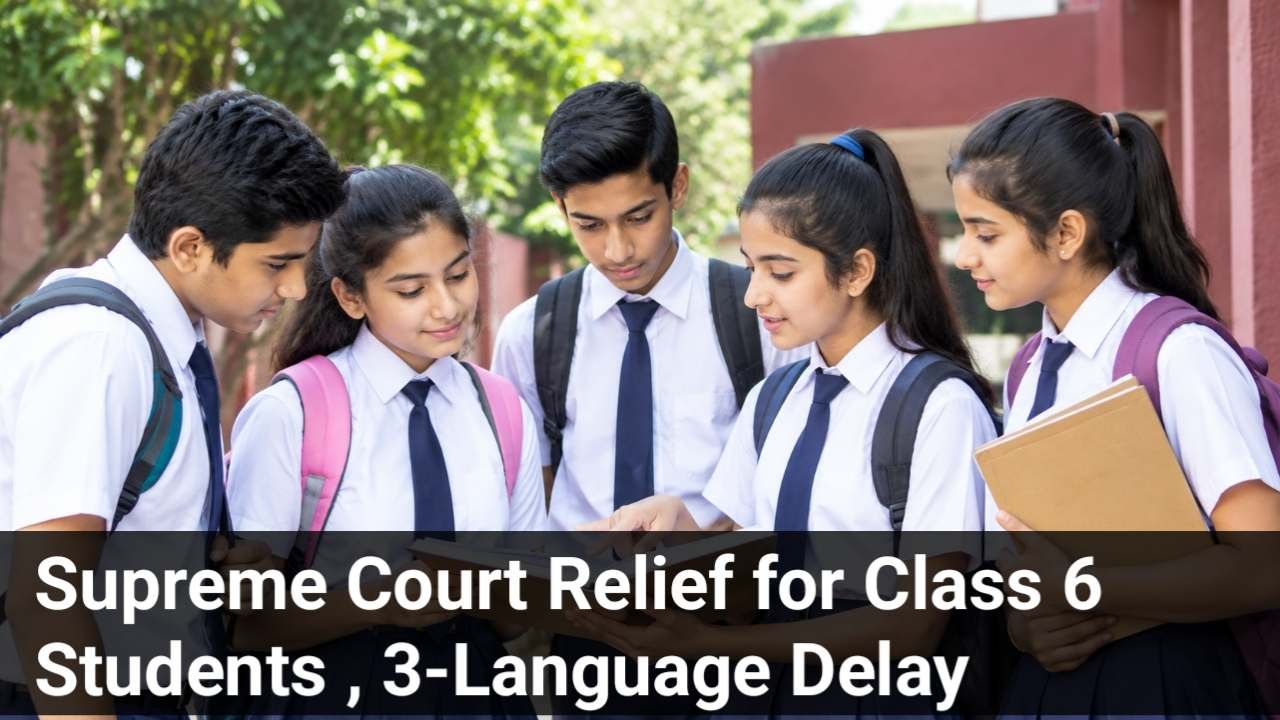
In a major relief for thousands of middle-school students and parents across the country, the Supreme Court of India has directed the Central Board of Secondary Education (CBSE) to grant a one-time exemption to the current Class 6 batch regarding the implementation of the Three-Language Policy.
A three-judge bench headed by Chief Justice Surya Kant, alongside Justices Joymalya Bagchi and V. Mohana, issued an interim order clarifying that the policy should now undergo a “soft launch” and be formally enforced starting from the April 2027 academic session, rather than being imposed mid-session.
SC Ruling on CBSE Three-Language Policy: Key Highlights
| Judicial Bench | Chief Justice Surya Kant, Justice Joymalya Bagchi, & Justice V. Mohana |
| Affected Batch | Current Class 6 Students (2026–27 Academic Session) |
| Exemption Status | One-Time Exemption Granted for Mid-Session Implementation |
| New Rollout Timeline | April 2027 Academic Session (Soft Launch Status) |
| Mandatory Requirement | Out of 3 languages, at least 2 must be native Indian languages |
| Class 10 Board Exam Exemption | Assessment of the additional Indian language remains internal/school-level |
| Next Hearing Schedule | Listed after 6 weeks for main constitutional questions |
Supreme Court Rationale: Mid-Session Stress vs. Readiness
While Solicitor General Tushar Mehta and Additional Solicitor General Aishwarya Bhati argued on behalf of CBSE that nearly 99% of 28,000 CBSE schools were equipped with textbooks and teachers, the apex court bench emphasized student welfare over statistical readiness:
- Mid-Session Disturbance: The bench highlighted that several months had already passed since the start of the April session. Introducing a third language abruptly mid-year would create unnecessary academic anxiety for children.
- Transition Time for Schools: Delaying full enforcement to April 2027 gives the remaining schools, publishers, and state boards (SCERTs) adequate time to finalize physical textbooks and complete teacher recruitment.
- Mental Health Concerns: Senior Advocates Gopal Sankaranarayanan and Anand Grover, representing the petitioners, noted that approximately 300,000 students were experiencing anxiety over mid-year syllabus changes.
CBSE Institutional Preparedness & Language Data
To demonstrate its readiness under National Education Policy (NEP 2020) and National Curriculum Framework for School Education (NCF-SE 2023), CBSE submitted data regarding resources and monitoring mechanisms:
Key Statistical Submissions by CBSE:
- Textbook Availability: Digital learning materials for the 3rd language across all 22 Eighth Schedule Indian languages are available on the official NCERT portal, catering to 98% of school choices.
- Implementation Monitoring Committee: A 5-member expert committee chaired by Bhagwati Prasad Kalal (Director, Ministry of Education) was constituted on September 16 to oversee the smooth transition across Classes 6 to 10.
Relief Clarifications for Senior Classes (7, 8, and 9)
For students in Classes 7, 8, and 9 who were previously studying two non-Indian languages, the Supreme Court and CBSE confirmed the following relaxed framework.
- Retaining Existing Subjects: Students can retain their current language combination while adding one Indian language to meet statutory requirements.
- No Board Exam Blockade: Assessment for the additional language will take place strictly at the internal school level. It will not carry board exam pass/fail weightage for Class 10 board exam results.
- Court Warning to Schools: The bench dismissed fears that schools might hold back students based on internal language assessments, stating that the court will closely monitor school-level evaluation practices.